
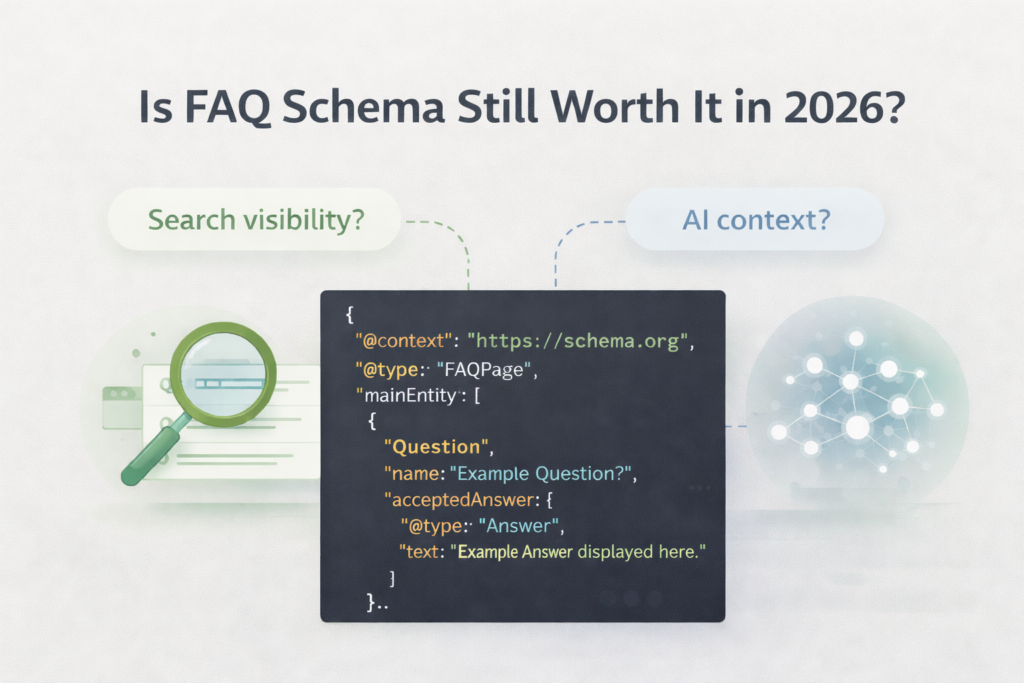
Over the past few years, FAQ schema has gone from “SEO must-have” to something many people are now questioning or dismissing entirely.
You’ve probably seen some version of this take:
“Google doesn’t show FAQ rich results anymore, so FAQ schema is dead.”
That conclusion is understandable. It’s also incomplete.
FAQ schema has changed in how it’s surfaced, but its underlying purpose hasn’t gone away. In fact, as search evolves and AI-driven systems become more prominent, how your content is understood matters more than ever.
This post breaks down what actually changed, what FAQ schema still does well, when it’s worth using, and when it’s not.
Why People Think FAQ Schema Is “Dead”
The skepticism didn’t come out of nowhere.
Over the last few years, Google:
- Reduced the visibility of FAQ rich results
- Became more selective about when FAQs appear in SERPs
- Tightened quality guidelines around structured data
As a result, many sites that once saw expanded FAQ listings in search results stopped seeing them altogether.
For some, that translated to:
“If I don’t get rich results, what’s the point?”
That framing misses what schema was always meant to do.
What FAQ Schema Was Never Meant to Guarantee
FAQ schema has never guaranteed:
- Rankings
- Rich results
- Featured placements
- Increased traffic on its own
Schema is not a ranking hack. It’s a clarification tool.
Its job is to help systems understand:
- What kind of content is on the page
- How questions and answers relate to each other
- What information is authoritative vs decorative
When Google decides to display rich results is a separate decision, and one you don’t control.
What FAQ Schema Still Does Well (and Always Has)
Even without visible rich results, FAQ schema still provides real value when used correctly.
It improves clarity
Schema removes ambiguity. Instead of guessing based on layout or headings, search engines are told explicitly:
- “This is a question”
- “This is the answer”
It supports content understanding
As search systems get better at interpreting meaning (not just keywords), clean structure matters more than ever.
It future-proofs content
Search features change. AI systems evolve. Structured data gives your content a stronger foundation regardless of how it’s surfaced next.
Schema isn’t about chasing a specific SERP feature; it’s about making intent clear.
Where AI Changes the Equation
Search engines aren’t the only systems interpreting your content anymore.
AI-powered tools, from search summaries to assistants and retrieval systems, rely heavily on:
- Clear structure
- Explicit relationships
- Machine-readable signals
While AI models don’t “rank” schema the way Google evaluates search results, structured data reduces guesswork.
It helps ensure:
- Questions are understood as questions
- Answers are understood as authoritative responses
- Content is summarized accurately instead of loosely inferred
In that sense, FAQ schema isn’t about optimizing for AI.
It’s about avoiding misinterpretation by AI.
When FAQ Schema Is Worth Using
FAQ schema makes sense when:
- Your FAQs are real and helpful
- Questions are genuinely answered on the page
- Content is written for users, not search engines
- FAQs reflect actual concerns or decision points
In these cases, schema reinforces what’s already there.
It doesn’t manufacture value; it clarifies it.
When FAQ Schema Is Not Worth Using
FAQ schema is not appropriate when:
- FAQs are thin or promotional
- Questions are written solely to target keywords
- Answers don’t provide meaningful information
- Content exists only to chase rich results
In those cases, schema won’t help and may even work against you.
Google’s increased selectivity isn’t about punishing schema. It’s about filtering low-quality usage.
Why Implementation Matters More Than Ever
As expectations tighten, how schema is implemented matters.
Manual snippets, duplicated content, or schema that doesn’t match visible content increase risk, especially when page builders are involved.
The safest approach is schema that:
- Reflects what users actually see
- Is generated consistently
- Avoids guesswork and automation shortcuts
If you’re using BeTheme, we’ve outlined a clean, no-code approach here:
How to Add FAQ Schema to BeTheme Without Code
And if you want to understand the difference between visual FAQ blocks and actual schema markup, this post walks through that distinction in detail:
BeTheme FAQ Blocks vs FAQ Schema: What’s the Difference?
So… Is FAQ Schema Still Worth It?
Yes. When it’s used for clarity, not shortcuts.
FAQ schema isn’t about forcing visibility. It’s about communicating meaning clearly in an environment where:
- Search engines are more selective
- AI systems are more prominent
- Structure matters more than presentation
If your FAQs are genuinely helpful, schema is still doing important work behind the scenes, even if you never see a flashy SERP enhancement.
And that quiet clarity is often what holds up the longest.
Final Thought
SEO has always moved in cycles. Features come and go. Best practices evolve.
But the underlying principle hasn’t changed:
Make your content easy to understand, for people and for machines.
FAQ schema, when implemented thoughtfully, still supports that goal.
If you’re looking for a simple, BeTheme-specific way to handle this without custom code or fragile workarounds, you can learn more here: